
Guide · Updated November 2026
Retainers after braces or aligners: fixed or removable?
Short answer: After braces or aligners, almost everyone needs a retainer, because teeth tend to move back towards where they started. A fixed retainer is a thin wire bonded behind the front teeth. A removable retainer is taken in and out and is usually worn part-time, on the schedule your orthodontist sets. Some people have both. Your orthodontist decides which suits you and for how long; professional bodies describe retention as long-term.
The day your braces come off, or you finish your last aligner, feels like the end of treatment. It is the start of its last stage: retention. This guide explains why retainers are needed, how the two main types differ, and how long they are usually worn.
After braces or aligners
- Fixed retainerA thin wire bonded behind the front teeth. It is not taken in and out.
- Removable retainerA clear tray or a plate with a wire. Taken in and out, and worn part-time as instructed.
- BothA fixed wire, with a removable retainer worn over it at night.
Why teeth move after treatment
The British Orthodontic Society (BOS) puts it simply: teeth tend to want to move back towards their original positions, and this is called relapse. It adds a second reason: as we get older, teeth may start to move unpredictably, often with some crowding. The BOS describes retainers as essential in almost all cases, to help prevent the teeth moving once braces are removed.
Dr Köni explains the first reason to his patients like this. Before treatment, your teeth sit where the forces on them are in balance: the lips and cheeks press from the outside, the tongue presses from the inside, and the way you chew plays a part too. That balance holds the teeth where they are, whether they are crowded or spaced. Treatment moves the teeth to a new position, but the muscles and habits take time to adjust to the new arrangement. The bone around the teeth also has to reshape around their new positions. While the bone is still settling and those pressures have not yet rebalanced, teeth that are left unsupported can drift back.
The American Association of Orthodontists (AAO) makes a related point about the bone: retainers support the bone around your teeth as they adapt to their new positions.
Fixed retainers
A fixed retainer is also called a bonded retainer or a permanent retainer. It is a slender wire bonded to the inner side of the front teeth, where it cannot be seen from the outside. Dr Köni usually places it from canine to canine, on the lower and the upper teeth.
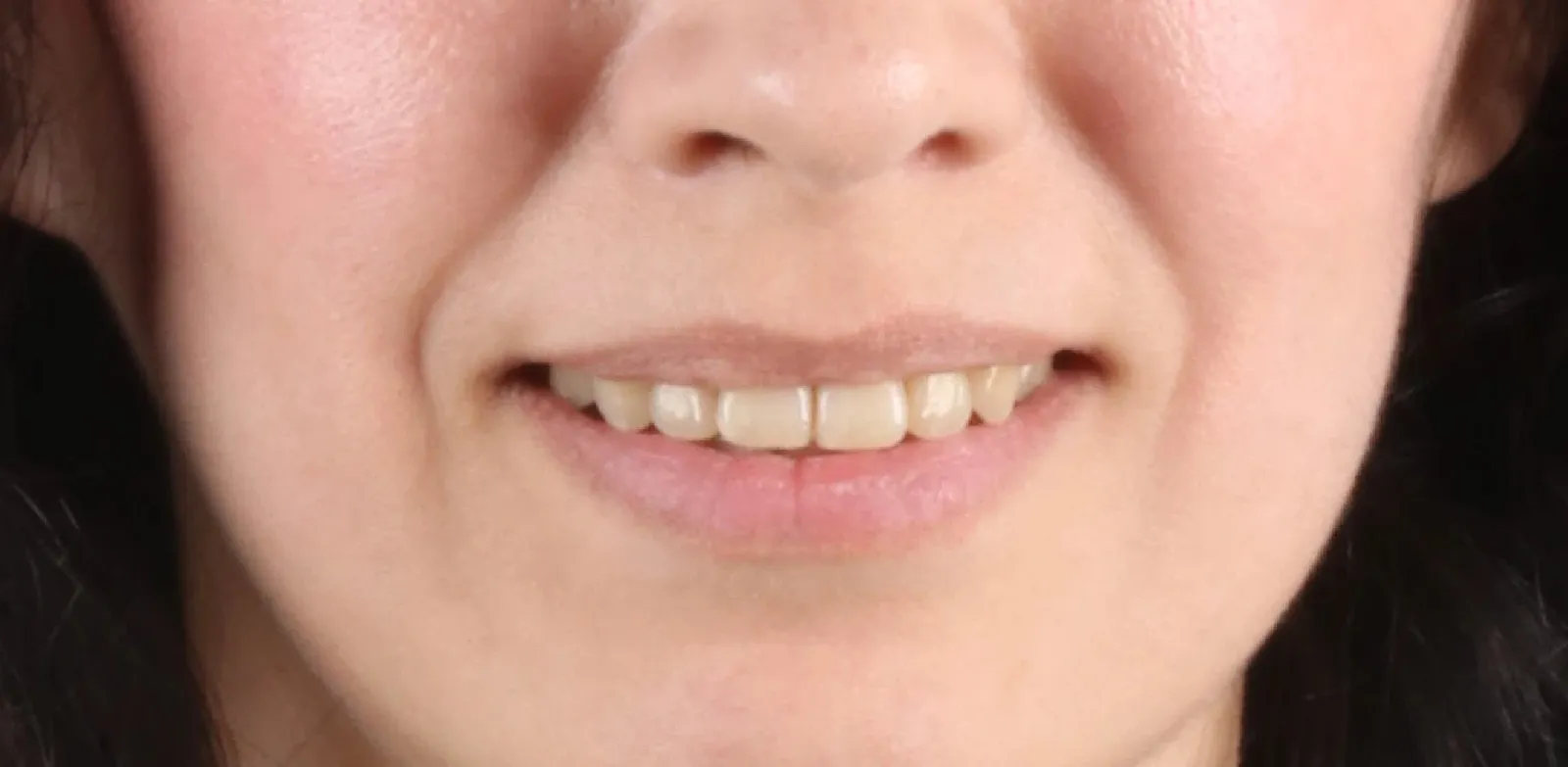
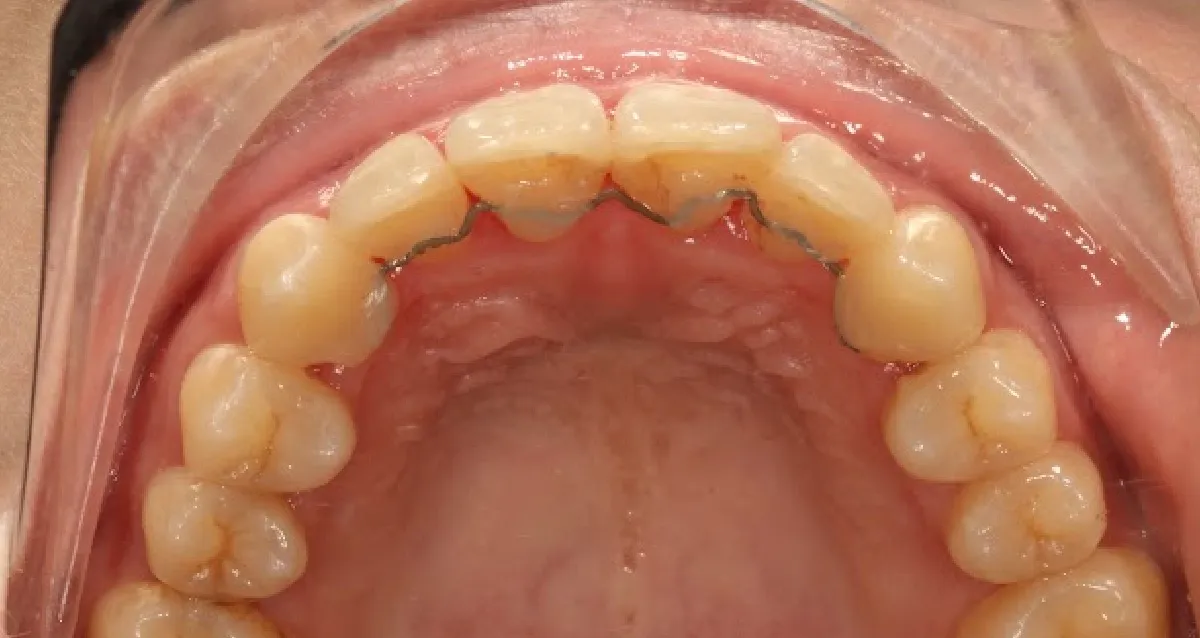
The same patient after orthodontic treatment, shown with the patient's written consent to illustrate where a fixed retainer sits. From the front the fixed retainer cannot be seen; from below, the wire sits on the inner side of the upper front teeth, canine to canine. Photos are unedited apart from cropping and resizing. Every patient's treatment and result is different.
- What is good about it: you do not have to remember to wear it (BOS).
- What it asks of you: extra time cleaning around it (BOS). Dr Köni stresses careful cleaning between the teeth in particular. The AAO also advises avoiding hard or sticky foods that may dislodge the wire.
- When it may not suit: in some patients the lower teeth touch the back of the upper front teeth heavily, or the bite is deep. In those cases, Dr Köni says, an upper wire can break or come away, and a removable retainer may be the better choice for the upper teeth.
“Permanent” is a name, not a promise. A wire can loosen or break. If it ever gets loose, the BOS advises seeking advice.
Removable retainers
Removable retainers come in two main kinds:
- Clear retainers (Essix, Vivera or similar) are thin plastic trays that sit over the teeth (AAO). They are made from clear thermoplastic; the BOS calls this type a vacuum-formed retainer. Essix and Vivera are brand names you may hear: Essix is one brand of the material (Raja et al., 2014), and Vivera is the clear retainer offered under the Invisalign name. The BOS says this type is usually worn part-time, and that you must never eat or drink with it in place.
- Hawley retainers have a plastic plate that sits behind the teeth and a thin metal wire across the front teeth. The BOS notes that speech may be affected slightly at first and that this quickly improves.
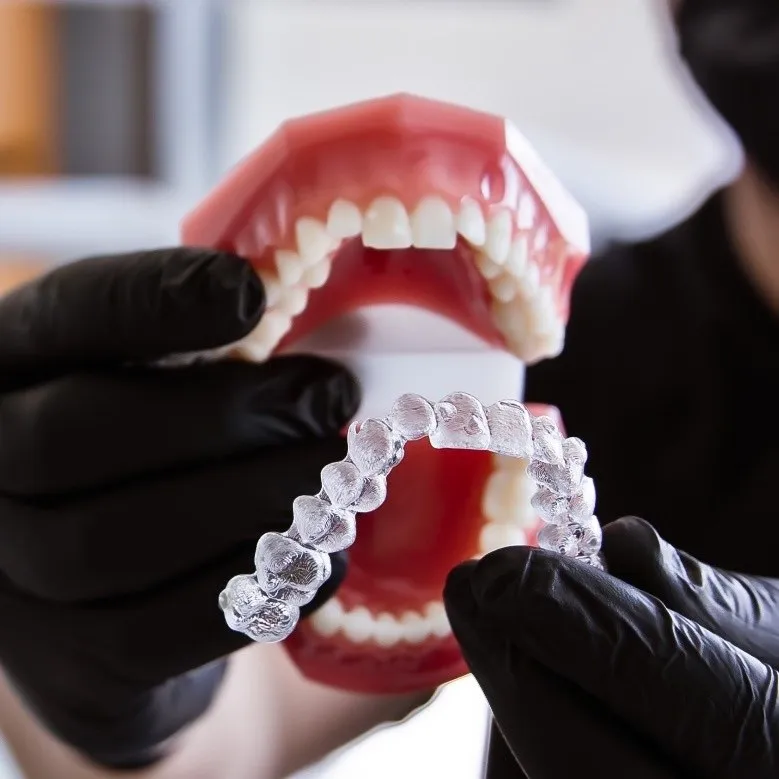
A clear removable retainer next to a dental model: a thin plastic tray shaped to fit over the teeth. Photo: Dr Köni.
The retainer brand names Essix and Vivera appear in this guide only to explain terms you may hear; the guide does not recommend one brand over another. Dr Köni is an Invisalign provider.
A removable retainer only works while it is worn. The schedule below is an example only: it is what Dr Köni usually asks of his own patients after examining them, and your own plan may differ.
- First month after treatment: 16 hours a day.
- Second month: 12 hours a day.
- From the third month: every night.
- After about one and a half to two years: every second night.
- About six months after that: two nights a week.
After that he reviews each patient. For some, the retainer is phased out gradually. For others, it is renewed and wear continues. Your own plan may differ, so follow the instructions your orthodontist gives you, and do not reduce or stop wear on your own.
The AAO advises brushing a removable retainer gently with a soft toothbrush and water, avoiding hot water because it can cause damage, and keeping the retainer in its case whenever it is not in your mouth.
When both are used
The BOS notes that sometimes more than one type of retainer is recommended. Dr Köni does this for patients who clench or grind their teeth at night: they have a fixed retainer, and they also wear a removable retainer over it at night as protection.
Is one type better?
Research does not give a clear winner. A Cochrane review updated in 2023 looked at 47 studies with 4,377 participants and concluded that firm conclusions cannot be drawn about any one approach to retention over another; it rated the evidence as low or very low certainty. Among removable retainers, it found that clear ones may give better patient satisfaction but may be less likely to last than Hawley retainers.
In practice the choice is individual. The BOS says it is affected by a number of different factors, and your orthodontist will explain which retainer suits you.
How long do retainers need to be worn?
Professional bodies describe retention as long-term and leave the detail to your orthodontist:
- The AAO says a retainer is typically necessary for a lifetime, though the frequency of wear may decrease over time.
- The BOS says: “The longer you wear retainers, the longer you can keep your teeth straight.”
- The NHS says the orthodontist will tell you how long you need to wear the retainer.
Dr Köni’s usual schedule, set out above, steps wear down to two nights a week by roughly two to two and a half years after treatment. He then reviews each patient: for some, wear is phased out gradually; for others, the retainer is renewed and wear continues. Phasing out is an individual decision made at that review, not a sign that teeth can no longer move. The BOS notes that teeth may start to move as we get older, so some movement is possible once a retainer is no longer worn.
If a retainer breaks, is lost or feels tight
- A fixed wire feels loose: seek advice (BOS).
- A removable retainer feels tight: the AAO says this might indicate that your teeth have shifted slightly. Ask your orthodontist what to do.
- A retainer is damaged, lost or no longer fits as it did: consult your orthodontist (AAO).
In each case the next step is the same: ask your orthodontist for advice.
Risks and limitations
Retainers are used to minimise relapse (AAO); no type of retainer rules out tooth movement altogether. A fixed wire can loosen or break, and it needs extra cleaning: if teeth are not kept clean around it, tooth decay or gum inflammation can follow. A removable retainer depends on being worn as instructed, and it can be lost or broken. The research comparing retainers is limited, so advice is based on your own teeth and bite and can change over time.
In Dubai specifically
- Long trips: if you spend summers abroad, take your removable retainer and its case with you. If a wire comes loose while you are away, the BOS advice still applies: seek advice.
- New to Dubai: if you finished treatment in another country, bring any instructions you were given about your retainers to your first appointment with an orthodontist here.
- Language: Dr Köni consults in English and Turkish.
Retainers follow almost all orthodontic treatment, whether it was done with fixed braces or clear aligners, Invisalign included. If you would like Dr Berk Köni, a specialist orthodontist in Dubai, to assess your teeth at Invisalign Center Dubai in Umm Suqeim 2, you can send a message through the enquiry form and say what you have noticed.